Master of Actuarial and Quantitative Risk Management (MAQRM)

We will start reviewing applications on a rolling basis on January 15. Final deadline to apply for the Autumn MAQRM cohort is April 1st.
Program Description
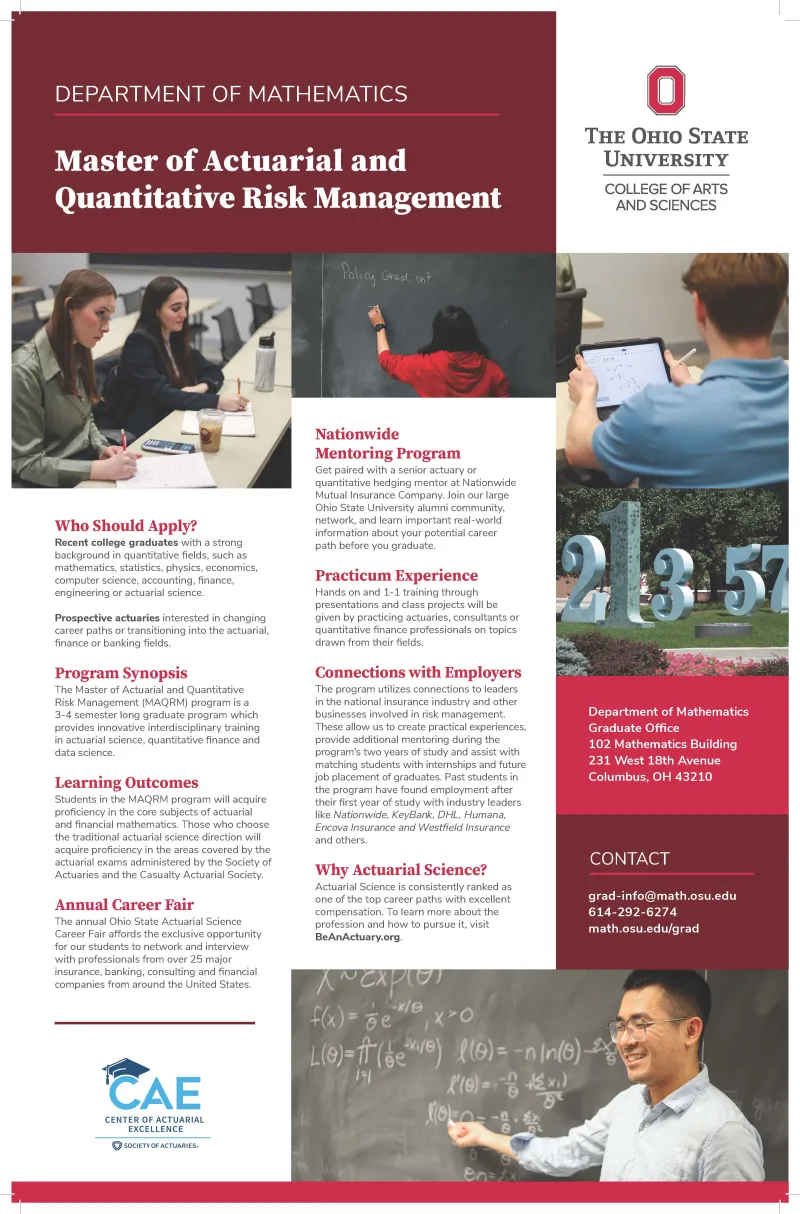
The Master of Actuarial and Quantitative Risk Management (MAQRM), inaugurated in 2016, is internationally recognized for its innovative curriculum and esteemed faculty. It is based on our tremendously successful undergraduate degree program in actuarial science that our department has been offering for over 45 years.
MAQRM provides a curriculum that combines training in modern mathematical finance and actuarial risk management - two areas that have become increasingly intertwined, creating a demand for graduates that have acquired expertise in both areas. The curriculum includes newly developed courses in quantitative risk management and financial stochastic calculus.
The program equips students with technical skills and knowledge to excel in today's actuarial and financial workplaces. Our innovative coursework is designed to exceed industry standards and anticipate the future needs of our graduates.
The program utilizes well-established connections to the nationwide insurance industry and other businesses involved in risk management in order to create practical experiences and provide additional mentoring during the two years of study in the program. These connections will also be instrumental in job placements of graduates.
At least 85% of our MAQRM students find jobs in their desired career paths at the time of graduation. Past students in the program have found employment with industry leaders like Westfield Insurance, Motorists Insurance Group, Encova Insurance, Humana, and DHL.
New to actuarial science? For information about this profession, go to BeAnActuary.org. For information about compensation in the actuarial profession, look at the DW Simpson Salary Surveys.
Career Success
Looking to connect with successful alumni and learn about their journey? Want to get more involved in the Actuarial Science community at Ohio State? Check out the Ohio State Actuarial Alumni Stories page for inspiring stories, career advice and real-life insights from fellow actuaries!
Also, don’t miss out on the Actuarial Science Club website! It’s packed with information on events, networking opportunities, and resources to help you on your path to success in the field!
- 33,600 Number of jobs in the US
- $194,703 Average Compensation (salary+bonus)
- 22% Projected growth in jobs (Much faster than everage)
Industry Engagement and Career Preparation
Ohio State’s actuarial program combines rigorous quantitative training with sustained industry engagement and a strong focus on professional development. Students prepare for actuarial and analytics careers through a curriculum designed to build technical depth, business judgment, communication skills, and professional readiness. A distinctive feature of the program is its close connection to employers: students have access to an exclusive actuarial science career fair with approximately 25 participating companies, along with additional recruiting events, employer presentations, and career panels throughout the year.
These opportunities expose students to a wide range of actuarial career paths, including insurance, consulting, small-company, large-company, life, health, property and casualty, and data analytics roles. The program’s practicum course further strengthens this connection by bringing 10–15 companies into the classroom each semester. Students work in teams on real-world case studies, analyze open-ended business problems, present their findings, and receive direct feedback from practicing professionals.
The program also provides structured support to help students prepare for the recruiting process. Students receive guidance on career fair preparation, job and internship applications, resumes, interviewing, and professional communication. Resume review sessions, mock interviews, and individualized advising help students present their qualifications effectively. Students who are interested may may also be paired with practicing actuaries in the workforce for mentoring, giving them additional insight into the profession and support as they navigate their career goals.
This combination of academic preparation, experiential learning, and repeated employer interaction helps students develop the skills and professional networks needed to enter the actuarial profession with confidence. Our graduates have an excellent record of securing entry-level actuarial positions and beginning successful careers in insurance, consulting, and related quantitative fields.
Practicum in Quantitative Risk Management
The Practicum Class is a signature component of the program and is required for all students. Throughout the semester, 10–15 companies visit the class to share insights into their work, career pathways in the industry, and current business priorities. Most companies also provides a case study for students to analyze over the following week.
Students work in teams to develop their analysis and present their findings when the professionals return to campus. The visiting professionals provide feedback and, in many cases, share how they would approach the same problem in practice. Case studies typically include open-ended business questions, data, and background information related to a specific product, business line, or analytical challenge.
The course gives students direct exposure to a wide range of actuarial and data analytics professionals, from recent alumni to senior executives. It is designed to help students strengthen their technical, communication, teamwork, and business problem-solving skills in a setting closely connected to professional practice.
- 1% Of all actuaries in the US are OSU alumni!
- 1 of 11 Universities in the US with BS, MS and PhD level training
- 10th Best Career (US news)
Innovative Curriculum
Our curriculum is designed to prepare students for multiple pathways into the actuarial profession, including both the Society of Actuaries (SOA) and Casualty Actuarial Society (CAS) credentialing tracks. Ohio State courses support preparation for SOA exams P, FM, SRM, FAM, ALTAM, ASTAM, and PA, as well as CAS Exams 1 and 2, MAS-I, MAS-II, and Exam 5. Students also have opportunities to pursue advanced coursework in stochastic calculus, financial risk modeling, and quantitative risk management, and to gain applied experience through the actuarial practicum. This combination of credential preparation, technical depth, and practical experience prepares graduates for actuarial and quantitative risk roles in insurance, consulting, finance, reinsurance, and related fields.
| Credentialing Area | Related OSU Courses |
|---|---|
| SOA Exam P / CAS Exam 1 | Math 4530 |
| SOA Exam FM / CAS Exam 2 | Math 3618 |
| SOA Exam SRM and Exam PA | Math 5637, Math 5638 |
| SOA Exam FAM | Math 5630, Math 5633 |
| CAS Exam MAS I | Math 5630, Math 5633, Math 5637, Stat 6301 |
| CAS Exam MAS II | Math 5633, Math 5634, Math 5637, Stat 6302 |
| SOA Exam ALTAM | Math 5631 |
| SOA Exam ASTAM | Math 5634 |
| CAS Exam 5 | Math 5194 |
| Advanced Stochastic Calculus for Financial Modeling | Math 5635, Math 5636 |
| Machine Learning in Finance | Math 5638 |
| Practicum Experience | Math 5588 |
Requirements
Required Preparations
- Multivariable Calculus on par with MATH 2153 Calculus III
- Calculus-Based Probability on par with MATH 4530 Probability or STAT 4201 Intro to Mathematical Statistics I
- GPA of 3.0 or higher for the last undergraduate (or graduate) degree earned*
* on a 4.0 scale, otherwise 75th percentile or better
Recommended Preparations
- Interest Theory on par with MATH 3618 Theory of Interest
- Micro & Macroeconomics on par with ECON 2001.01 or .03H Principles of Microeconomics and ECON 2002.02 or .03H Principles of Macroeconomics
- Intro to Computer Programming of one of the following CSE 1222 Intro to Computer Programming in C++, CSE 1223 Intro to Computer Programming in Java, or CSE 1224 Intro to Computer Programming in Python
- Major or minor in a quantitative field (mathematics, physics, statistics, engineering, computer science, economics, etc)
Documents
- Transcript, which should include courses taken in advanced calculus and calculus-based probability. A 4-year BS or BA degree is required to be a graduate student in the MAQRM program.
- Three reference letters from writers qualified to judge the applicant's academic and professional abilities.
- CV and Statement of Purpose describing your background and professional goals.
- Excellent English skills for students from non-English speaking countries. TOEFL or IELTS scores must be submitted (not required for domestic students).**
**TOEFL scores are waived for applicants who complete a Bachelor's or Master's degree from a U.S.-based college prior to matriculation
Sample Program
Exact degree requirements can be found under the MAQRM Current Students section of the website. An example of the typical courses a student in this program would take is included below.
Sample Schedule for MAQRM Program (Non-Thesis)
YEAR 1
- Autumn Semester Total Hours: 6 for degree, 9 overall
- Course 1: STAT 6301 (3 cr. hrs.) Core
- Course 2: MATH 5630 (3 cr. hrs.) AQRM Sequence
- Course 3: MATH 3618 (UG 3 cr. hrs.) No Graduate Credit - Remedial
- Spring Semester Total Hours: 9
- Course 1: STAT 6302 (3 cr. hrs.) Core
- Course 2: MATH 5631 (3 cr. hrs.) AQRM Sequence
- Course 3: STAT 6540 (3 cr. hrs.) Sample Elective
- Summer Semester Total Hours: 0
- Course 1: Optional
YEAR 2
- Autumn Semester Total Hours: 9
- Course 1: MATH 5632 (3 cr. hrs.) Core
- Course 2: MATH 5633 (3 cr. hrs.) AQRM Sequence
- Course 3: STAT 6560 (3 cr. hrs.) Sample Elective
- Spring Semester Total Hours: 9
- Course 1: MATH 5634 (3 cr. hrs.) AQRM Sequence
- Course 2: MATH 6550 (3 cr. hrs.) Sample Elective
- Course 3: MATH 5588 (3 cr. hrs.) Practicum in AQRM (Core)
Total Class Hours: 30 Practicum Hours: 3
Sample Schedule for MAQRM Program (Thesis)
YEAR 1
- Autumn Semester Total Hours: 9
- Course 1: STAT 6301 (3 cr. hrs.) Core
- Course 2: MATH 5632 (3 cr. hrs.) Core
- Course 3: MATH 5633 (3 cr. hrs.) AQRM Sequence
- Spring Semester Total Hours: 8
- Course 1: STAT 6302 (3 cr. hrs.) Core
- Course 2: MATH 5634 (3 cr. hrs.) AQRM Sequence
- Course 3: STAT 5740 (2 cr. hrs.) Sample Elective
- Summer Semester Total Hours: 0
- Course 1: Optional
YEAR 2
- Autumn Semester Total Hours: 8
- Course 1: MATH 5635 (3 cr. hrs.) AQRM Sequence
- Course 2: STAT 6550 (2 cr. hrs.) Sample Elective
- Course 3: STAT 6560 (3 cr. hrs.) Sample Elective
- Spring Semester Total Hours: 9
- Course 1: MATH 5636 (3 cr. hrs.) AQRM Sequence
- Course 2: MATH 5588 (3 cr. hrs.) Practicum in AQRM (Core)
- Course 3: MATH 6999 (3 cr. hrs.) Thesis Writing
Total Class Hours: 27 Practicum Hours: 3 Thesis Hours: 3
Funding
Our department does not provide funding for MAQRM students. Students accepted to the program will need to provide or obtain their own financial support. For costs, please refer to the university's graduate Tuition and Fee Tables.
For housing information and costs, see our Graduate Student Living Guide.
Funding options for domestic students
U.S. citizens and permanent residents are eligible to apply for government-sponsored loans. Applicants should complete the Free Application for Federal Student Aid (FAFSA) by February 1 each year to be considered for federal loan programs, which typically have low, fixed interest rates and good repayment options. Private loans are also an option for students. Financial aid inquiries can be directed to OSU's Office of Student Financial Aid. Student employment opportunities are listed on the Student Job Board and Handshake.
Funding options for international students
Most international students may work up to 20 hours per week on campus. Learn more about employment for international students. The Ohio State Office of International Affairs provides some scholarships and grants for eligible graduate students. They also have information about external funding.
If you have further questions about the MAQRM program, the curriculum, or the content of courses, please contact Professor John Holmes. For questions about applying, contact grad-info@math.osu.edu.
Frequently Asked Questions (FAQ)
1. Does the program offer financial aid?
Financial aid is generally not available for this program. However, MAQRM students may be eligible to compete for select scholarships. For more details, please visit our scholarship page.
2. Can graduates from this program compete for jobs in the financial industry?
Yes. While our program is grounded in actuarial science, many students pursue careers in mathematical finance and related fields. We offer core courses in mathematical finance and machine learning for finance, providing a strong foundation for careers in banking, finance, pensions, consulting, insurance, and reinsurance. Our graduates are well-equipped to succeed in a variety of financial industry roles.
3. How is your program different from other programs?
Our program holds the prestigious Center of Actuarial Excellence (CAE) designation from the Society of Actuaries (SOA), awarded only to programs that meet rigorous standards across eight key areas, including curriculum quality, graduate outcomes, industry integration, and research excellence. We are one of just 11 universities in the U.S. offering actuarial training at the Ph.D. level, reflecting the high caliber of our faculty and academic environment. Our industry connections are second to none and every student engages with alumni and recruiters throughout their time in the program.
4. How long does it take to complete the program?
The program typically requires 33 credit hours and can be completed in three semesters. In some cases, students may finish in two semesters, particularly those with a strong actuarial background. Students entering without prior experience in actuarial science often take four semesters to complete the program. Entry is available in both the Fall and Spring semesters.