Vitaly Bergelson, Distinguished Professor of Mathematics and Physical Sciences at The Ohio State University, has been awarded the Stefan Banach Medal by the Presidium of the Polish Academy of Sciences [7]. The award was presented to Vitaly on June 24, 2025 at the Institute of Mathematics of the Polish Academy of Sciences during the conference Perspectives on Ergodic Theory and its Interactions. The Stefan Banach Medal, established on the centenary of his birth in 1992, is awarded for “outstanding contributions to the development of the mathematical sciences.” Other recent international awardees include Michel Talagrand (2022) and Timothy Gowers (2011).
The 2025 award recognizes Vitaly Bergelson for his contributions to ergodic theory, Ramsey theory, and combinatorial number theory. Ergodic theory studies long-term statistical properties of dynamical systems. Ramsey theory studies how large a mathematical structure must be to guarantee the existence of a particular substructure with a specified property. And combinatorial number theory studies how sets of numbers transform under addition and multiplication.
Vitaly acquired from his advisor, Hillel Fustenberg, an aesthetical preference for open but simply posed problems. Examples in combinatorial number theory include asking whether large enough sets of integers contain patterns of a certain sort [Figure 2]. Starting with such basic open problems, Vitaly’s work mixes and extends ideas between seemingly disparate fields, such as the theory of dynamical systems and the theory of ultrafilters [3], to obtain a body of results and techniques that have touched a great deal of combinatorics. A recent example of such work is a generalization of the Prime Number Theorem, a statement about the distribution of prime numbers, to a general observation about dynamical systems, systems that undergo transformations in time [2].
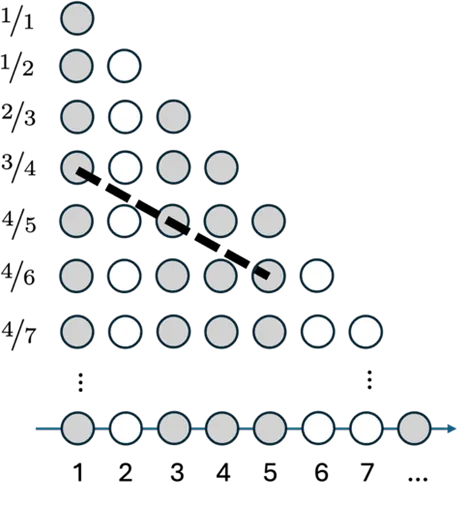
A set X of natural numbers can be visualized by filling in circles on the number line given at the bottom of the figure. Numbers on the left indicate the fractions of natural numbers {1,2,…n} that lie in X for n=1,2,3… Those fractions converge to the density of X. The dotted line indicates an arithmetic progression in X of length 3.
FIGURE 2. PATTERNS IN LARGE SETS OF NUMBERS
A characteristic feature of Vitaly’s results is that they often specialize from observations about abstract algebraic structures to concrete statements that are at once surprising and accessible. The celebrated Szemerédi’s Theorem, settling a conjecture of Erdős and Turán, asserts that sets of positive density contain arithmetic progressions of arbitrary length [Figure 2]. One of Vitaly’s early results generalizes Szemerédi’s Theorem to handle patterns much more general than arithmetic progressions, such as polynomial progressions [1]. The following example is a special case of a more general result about finite fields.
THEOREM 6.6 [4] (special case): For each prime p, integer k>0 and sequence
s1, s2, s3, …, sn
of integers of some sufficiently large enough length n possibly dependent on p and k, there exists a non-zero integer z such that each of the integers zk +s1, zk +s2, zk +s3, … zk +sn is the kth power of an integer modulo p.
One major theme throughout Vitaly’s work is the reconceptualization of large-scale structures (such as those of interest in Ramsey Theory and Number Theory) as long-term behavior in dynamical systems (Ergodic Theory). This leads to impressive results about the abundance of polynomial patterns in large sets of integers [1], the distribution of primes [5], and problems in the theory of Diophantine approximations [2]. In fact, Vitaly’s work lays many of the foundations for Ergodic Ramsey Theory, with numerous applications throughout abstract algebra, dynamics, and combinatorics.
REFERENCES
[1] Bergelson, Vitaly, and Alexander Leibman. "Polynomial extensions of van der Waerden’s and Szemerédi’s theorems." Journal of the American Mathematical Society 9.3 (1996): 725-753.
[2] Bergelson, Vitaly. "Ergodic theory and Diophantine problems." Topics in symbolic dynamics and applications (Temuco, 1997) 279 (2000): 167-205.
[3] Bergelson, Vitaly, and Randall McCutcheon. "Idempotent ultrafilters, multipleweak mixing and Szemerédi’s theorem for generalized polynomials." Journal d'Analyse Mathématique 111.1 (2010): 77-130.
[4] Bergelson, Vitaly, and Daniel Glasscock. "On the interplay between additive and multiplicative largeness and its combinatorial applications." Journal of Combinatorial Theory, Series A 172 (2020): 105203.
[5] Bergelson, Vitaly, and Florian K. Richter. "Dynamical generalizations of the prime number theorem and disjointness of additive and multiplicative semigroup actions." Duke Mathematical Journal 171.15 (2022): 3133-3200.
[6] Vitaly’s professional site: https://people.math.osu.edu/bergelson.1/
[7] Stefan Banach Award site: https://www.impan.pl/en/activities/awards/the-stefan-banach-medal